The policy of the Directorate General of Vocational Education of the Ministry of Education and Culture as stated in the Renstra of the Directorate General of Vocational Education of the Ministry of Education and Culture 2020-2024, vocational education focuses on: Development of vocational fields in machinery and construction; Creative economy; Hospitality; Nursing services.
Meanwhile, the creative economy sub-sectors according to the Ministry of Tourism and Creative Economy/Baparekraf of the Republic of Indonesia, include: Game Developers, Crafts, Interior Design, Music, Fine Arts, Product Design, Fashion, Culinary, Film, Animation, Video, Photography, Visual Communication Design, Television and Radio, Architecture, Advertising, Performing Arts, Publishing, Applications.
The establishment of a food service business study program is considered to be in line with the focus of vocational education planned by the Directorate of Vocational Education, Ministry of Education and Culture. Food Service Business is a profession that has a variety of jobs. Jobs that can be developed by professional enthusiasts ranging from simple to global-minded such as family food businesses (home industries), restaurants, catering and culinary tourism.
Because food is a basic need, because without food people cannot be active and work, the food business is a business that is widely favored by members of society. Food service businesses require managerial personnel at the bachelor's level who directly apply applied knowledge and skills, therefore a study program in the field of Food Services is needed that can be used as a reference to produce professional, globally qualified and internationally competitive catering entrepreneurs.
Considering external conditions related to the needs of the Vocational field in various study programs, especially for managerial staff in the food service business, YPSPIAI established a Vocational School based on the Decree of the YPSPIAI Management No.: 003C/SK/YPSPIAI/III/2023 concerning the Establishment of the Vocational School of Djuanda University, Bogor.
Furthermore, the study program that has been held since the 2024/2025 academic year is the Applied Bachelor/D4 Food Service Business (BJM) study program and has obtained BAIK accreditation based on LAMEMBA Decree No: 094/DE/A.5/AR.11/XII/2023 concerning the fulfillment of the minimum accreditation requirements for the Food Service Business Study Program at the Diploma Four Program at Djuanda University Bogor.
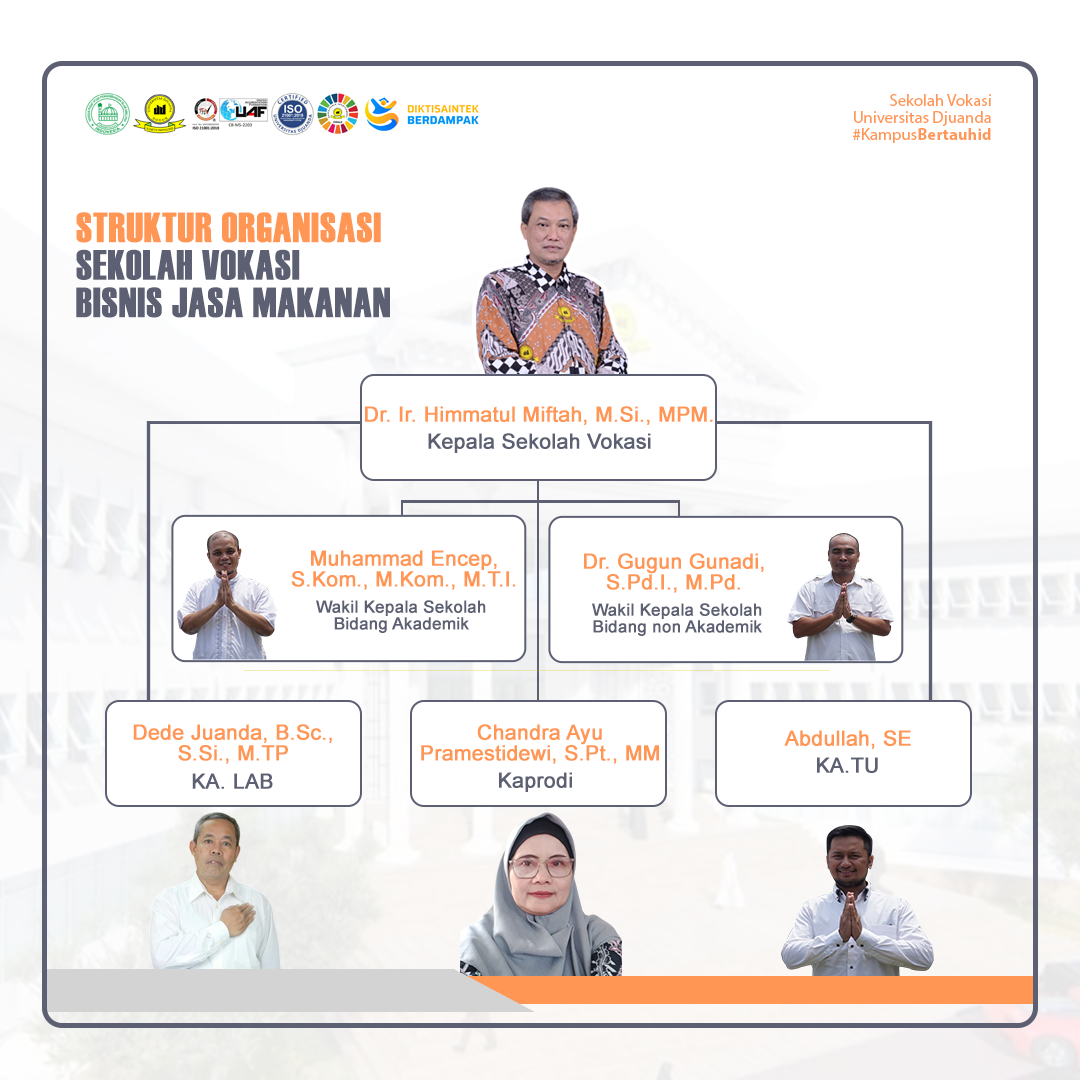
The opening of the Food Service Business Study Program Applied Bachelor Program based on the Decree of the Minister of Education, Culture, Research and Technology of the Republic of Indonesia No: 277/D/OT/2023 concerning Permit to open the Food Service Business Study Program Applied Bachelor Program at Djuanda University which is organized by the Indonesian Amaliyah Islamic Development Study Center Foundation (YPSPIAI). Currently, the Vocational School is led by a Principal at the Dean level assisted by a Vice Dean for Academic Affairs and a Vice Dean for Non-Academic Affairs.
Each study program is led by a Head of Study Program assisted by a Secretary of Study Program. Administrative matters at the Vocational School and study programs are handled by a Head of Administration and administrative staff.
To become a leading vocational school to enlighten the life of the nation that is united in monotheism and has international standards.